What’s living in these woods???
More than you might imagine! In addition to the obvious trees, plants, flowers and slugs, you might come across possum or deer on your walk. You could even encounter a mountain lion or a bear! But along with the flora and fauna that you would expect to find in a dense, damp forest, there are many living organisms that defy those two classifications. You probably know that the multitude of mushrooms that sprout playfully after the rains are fungi. Pay attention and you also might spot one of the many colorful slime molds that feed on the dead trees.
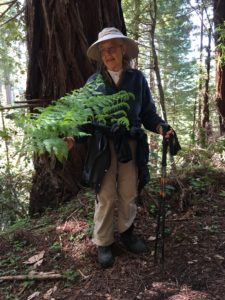
Darlene LaMont spent four decades exploring and supporting the Tannery Creek watershed. This local anthropologist and professional photographer shared her research with us in the following pages. (Note: Most, but not all, of the photos in these pages are Darlene’s. Some have been contributed by Kelly Bates.)
For a brief lesson in classifying biological systems:
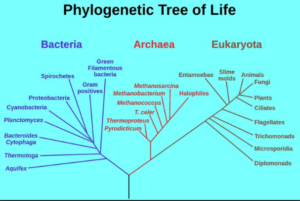
Genetic sequencing has given researchers a whole new way of analyzing relationships between organisms. Under the Three Domain System the kingdoms are Archaebacteria (ancient bacteria), Eubacteria (true bacteria), Protista, Fungi, Plantae, and Animalia. A protist is any eukaryotic organism that is not a plant, animal or fungus. The protists do not form a natural group, or clade, but are often grouped together for convenience, like algae or invertebrates.
Click on the links below to see photos and learn more about what you might encounter while walking through the Tannery Creek Reserve.
All of the animal life of a particular region or time.
The plant life occurring in a particular region or time, generally the natural or indigenous plant life in a location.
A characteristic that places fungi in a different kingdom from plants, bacteria, and some protists is chitin in their cell walls. Similar to animals, fungi acquire their food by absorbing dissolved molecules, typically by secreting digestive enzymes into their environment. Fungi do not photosynthesize. Growth is their means of mobility, except for spores, which may travel through the air or water.
Fungi perform an essential role in the decomposition of organic matter and have fundamental roles in nutrient cycling and exchange in the environment.
To learn more about local mushrooms, visit the Sonoma County Mycological Society at www.somamushrooms.org.
While not fungi, slime molds often form spore-bearing structures that resemble those of the true fungi. Although many slime mold species fruit on wood they do not form a penetrating and absorptive mass of hyphae in the wood substrate. Rather, slime molds form structures called plasmodia which are naked (i.e., without cell walls) masses of protoplasm which can move and engulf particles of food in an amoeboid manner. Slime mold plasmodia creep about over the surfaces of materials, engulfing bacteria, spores of fungi and plants, protozoa, and particles of nonliving organic matter. At some point, plasmodia convert into spore-bearing structures.
One of the most commonly encountered slime molds is the yellow Physarum polycephalum, a plasmodial slime – a single cell full of many nuclei, a light yellow slime mold that moves down the face of a log. The term slime mold refers to several kinds of unrelated eukaryotic organisms that can live freely as single cells, but aggregate together to form multicellular reproductive structures. At some phases of their life cycle they look like gelatinous “slime”. They are usually small, but some reach sizes of up to several square meters and masses of up to 30 grams. As long as food is abundant, these slime molds exist as single-celled organisms. When food is in short supply, many of these single-celled organisms will congregate and start moving as a single body. In this state they are sensitive to airborne chemicals and can detect food sources. They can readily change the shape and function of parts and may form stalks that produce fruiting bodies, releasing countless spores, light enough to be carried on the wind or hitch a ride on passing animals. They are usually found on the forest floor, commonly on deciduous logs. Slime molds can generally be divided into two main groups: A plasmodial slime mold is enclosed within a single membrane without walls and is one large cell. This “supercell” (a syncytium) is essentially a bag of cytoplasm containing thousands of individual nuclei. By contrast, cellular slime molds spend most of their lives as individual unicellular protists, but when a chemical signal is secreted, they assemble into a cluster that acts as one organism.
For an introduction to slime molds: http://www.ucmp.berkeley.edu/protista/slimemolds.html
An interesting read about how slime molds travel: The slime mold express. http://www.sciencemag.org/news/2010/01/ride-slime-mold-express.