Ferns
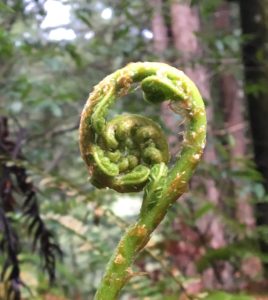
Fiddlehead (young, curly, unfurled fronds)
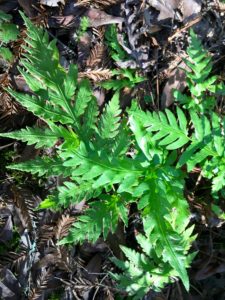
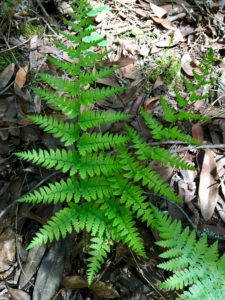
Can you identify these fern fronds???
California maiden-hair fern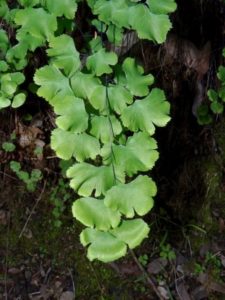
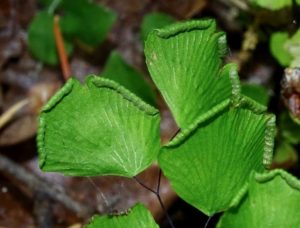
California Maiden-hair Fern (Adantum jordanii). Each trailing frond may reach over half a meter in length and is made up of many rounded green segments. Each segment has 2 to 4 lobes and may split between the lobes. The underside of each segment has 1 to 4 sori under the curled edge. Sadly Maiden-hair is a carrier of the fungus-like oomycete – Phytophthora ramorum, which causes Sudden Oak Death. The USDA enforces an import control, focusing intensely on areas (CA, OR, NY in U.S.) that are infected with Sudden Oak death. When sold, they must be identified by place of origin and must also be accompanied by a phytosanitary certificate. The USDA warns to not take cuttings from wild specimens. The edges curl to protect spores in the spring.
Coastal wood ferns (Dryopteris arguta)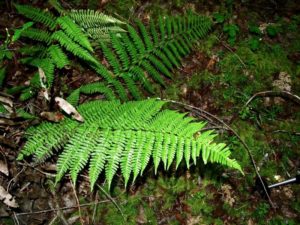
Coastal Wood-fern fronds do not have the hilt that the Sword Fern does. Its leaflets sometimes turn at an angle from the leaf, giving it a ruffled or lacy look. The toothed leaflets may have bristles at their tips. This fern normally grows on north slopes and/or shady creeks. 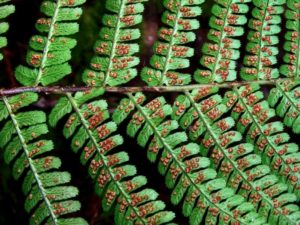
The under-side a mature leaf, the Coastal Wood-fern develops C-shaped sori (spore cups). The spores are eventually released and scattered by wind. If they land in a good spot they develop into a very small, short-lived plant that is the sexual generation. Each of these tiny plants produces sperm, eggs or both. The sperm needs a film of water to swim to the eggs. Once fertilized the egg develops into a new plant with one leaf, one stem and one root. As soon as the young fern becomes independent, the tiny mother plant dies.
Five-finger fern 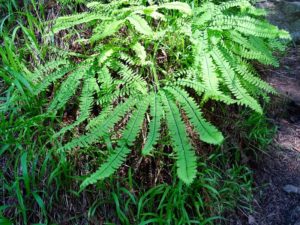
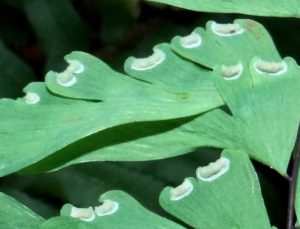
Five-finger (Adiantum pedatum/aleuticum) has a frond arranged in a fan-like form. It features finely-textured, somewhat frilly fronds which have curved stems and are divided into finger-like projections). Their wiry stems are reddish-brown to black. Young fiddleheads emerge pink in spring. Later, the leaflets will curl over to protect the sori (spores develop inside the curl.)
Sword fern, Western
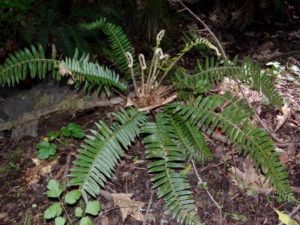
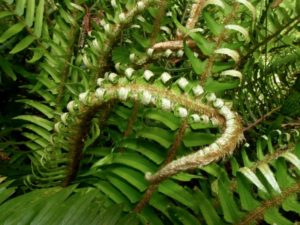
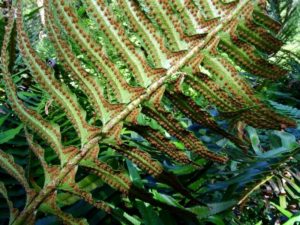
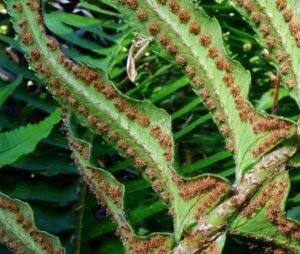
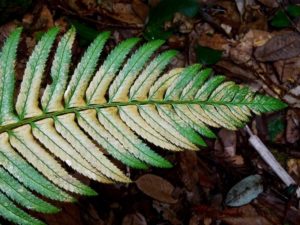
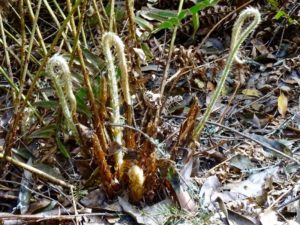
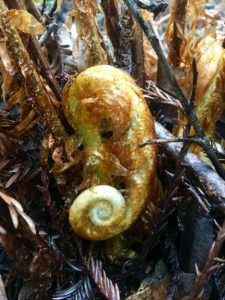
Western swordfern (Polystichum munitum) prefers to live in the understory of moist coniferous forests at low elevations. It grows best in a well-drained acidic soil of rich humus and small stones – like a redwood forest. Sword ferns are very tough and can survive occasional dry periods, but do well only with consistent moisture, light sunlight, and prefer cool weather to overly warm. The fronds are often over 3-4’ long – and can be identified by the “hilt” next to the stem (rachi). In the spring the young fronds (fiddleheads) appear and begin to slowly unroll. When the fronds mature they develop clusters of brown spore cases (sori) on their undersides. Many of the swordfern along the Tannery Creek trails have been attacked by Thrips (Exopterygota) because of the drought. Thrips are minute (1 mm long or less), slender insects with fringed wings and unique asymmetrical mouthparts. They puncture and suck up leaflet’s sap. The adults and pupae overwinter in the soil. In spring, newly emerged females insert eggs into the tissues of leaves or stems. (Thrips do not need to mate for reproduction! There may be 12-15 generations per year with the entire cycle from egg to adult requiring less than 16 days in warm weather.) The opportunistic thrips slowly weaken the swordfern (and other plants), reduce the number of sori produced – and can eventually kill the plant.