Beaked Hazelnut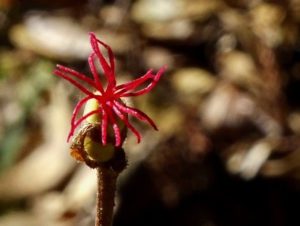
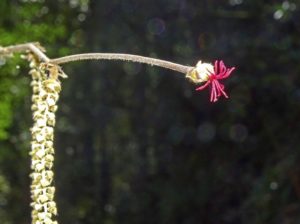
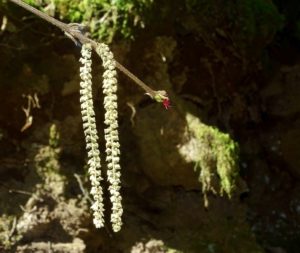 The Beaked Hazelnut (Corylus cornuta var. californica) is a monoecious (pronounced moan-EE-shus) plant. That means that it has separate male flowers and female flowers blooming on the same plant. The male flowers are catkins that begin to form in the fall and produce pollen in the following spring. The tiny bright red female flowers are pistillate (have no stamins) and are very difficult to find, even if you are looking. The commercial species of these nuts in Oregon is called filberts. The species in California doesn’t produce enough nuts for the commercial market.
Bermuda Sunshine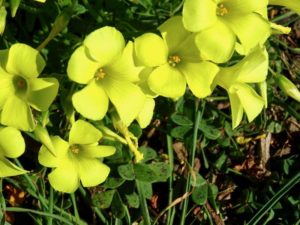 Bermuda buttercup (Oxalis pes-caprae) is super tasty, an excellent salad green including the flower. However it contains oxalic acid and should not be consumed in enormous quantities. It produces small bulbs copiously, where most other African species produce fewer, larger bulbs. New world Oxalis, such as Redwood Sorrel (Oxalis oregana), apparently does not generally produce bulbs. The plant has a reputation for being very difficult to eliminate once it has spread over an area of land. The weed propagates largely through its underground bulbs and this is one reason why it is so difficult to eradicate, as pulling up the stems leaves the bulbs behind. Soil in which the plant has grown is generally filled with small bulbs. It also has a huge number of common names: Bermuda buttercup, African wood-sorrel, Bermuda sorrel, Buttercup oxalis, Cape sorrel, English weed, Goat’s-foot, Sourgrass.
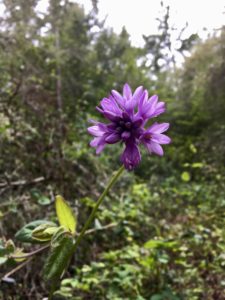
Bluedick
Blue Balls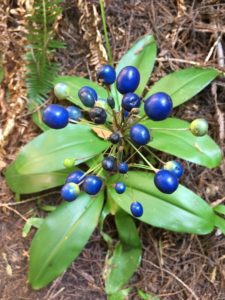
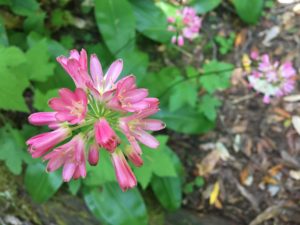 Clintonia andrewsiana, fondly referred to as “Blue Balls”, is a lovely lily with a bunch of bell shaped red flowers and broadly ovate shiny leaves followed by sexy shiny blue fruit that make an appearance after the flower has gone. The berries are a favorite of deer. It is found in the coastal fog belt of northern California and southern Oregon. It is often found growing in or at the edge of the forest with Trilliums and other forest plants. The leaves stay green throughout the dry summer and sometimes almost until new ones are produced in winter.
Broad-leaved helleborine (Epipactis helleborine) – a beautiful orchid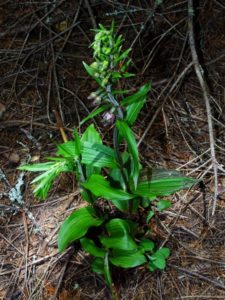 Broad-leaved helleborine (Epipactis helleborine) can grow to a height of 2.5′ and has broad dull green leaves which are strongly ribbed and flat.
 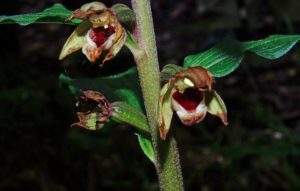 The flowers are arranged in long drooping racemes with dull green sepals and shorter upper petals. The lower lip is pale red and is much shorter than the upper petals. Its nodding flowers vary from greenish pink to purple, and it prefers shaded woodland environments.
 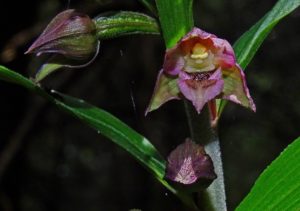 It is widely naturalized in the US and is increasingly considered invasive, in areas including Michigan, Wisconsin and the San Francisco Bay Area. They have been found to contain naturally occurring oxycodone (as well as another narcotic-like opioids) in minute amounts. There are many subspecies around the world. (Text adapted from Wikipedia.)
Cat’s ear, smooth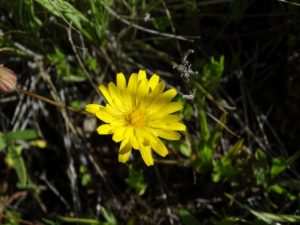
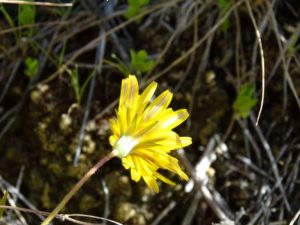
Smooth Cat’s ear (Hypochaeris glabra) is a non-native plant in the Aster Family and is sometimes called a False Dandelion. It is an annual herb with a small taproot and a basal rosette of leaves. The leaves form a rosette at the base of the plant. They are smooth along the edges or with small lobes, and green – sometimes with a purplish tint near the veins. Atop the thin, naked stems are flower heads with bright yellow ray florets and small overlapping purple-tipped phyllaries (modified leaves that form a collar at the base of the flower head). The leaves can be used in salads and the root can be roasted and ground to form a coffee substitute.
Cat’s ear, rough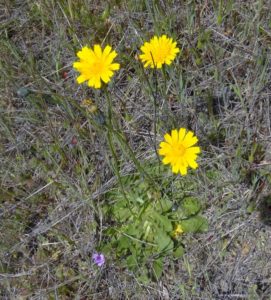 Rough Cat’s-ear (Hypochaeris radicata) is also called Hairy Cat’s-ear. And there are lots of different species of dandelions that look a whole lot like these.
Ceanothus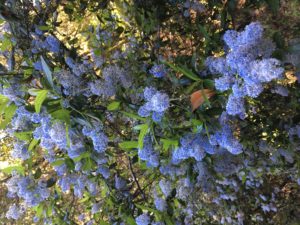 Ceanothus is a genus endemic to North America, especially California, of about 50–60 species of nitrogen-fixing shrubs or small trees in the family Rhamnaceae. The one here is Blue Blossom (Ceanothus thyrsiflorus). As a shrub, it attains heights of up to 10 feet but in tree form it will grow more than twice that tall. The leaves have a shiny upper surface that feels “gummy” when pinched between the thumb and forefinger, and the roots of most species have red inner root bark. The flowers are white, greenish–white, blue, dark purple-blue, pale purple or pink, maturing into a dry, three-lobed seed capsule. The flowers are tiny and produced in large, dense clusters. A few species are reported to be intensely fragrant almost to the point of being nauseating, and are said to resemble the odor of “boiling honey in an enclosed area”. Ceanothus species are typically dependent on forest fires to trigger germination of their seeds. The fruits are hard, nutlike capsules.
Douglas Iris
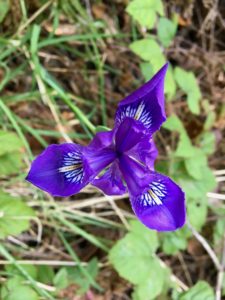
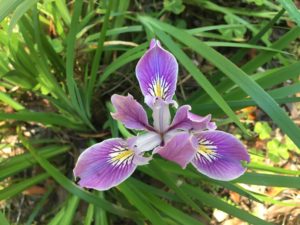 The rhizomes of Mountain iris or Douglas iris spread slowly, eventually creating a 2-4 ft. wide clump. Tufts of 1-2 ft., sword-shaped, dark-evergreen leaves arise from the rhizome and surround a flowering stalk of equal height. Several showy iris blossoms emerge from leafy bracts atop the stalks. The flowers are usually blue, though the colors can range from pale cream to yellow to reddish purple.
This is a common iris in the Redwood region and can be quite abundant in the Tannery Creek Reserve. In Greek mythology, Iris, a member of Hera’s court and goddess of the rainbow, so impressed Hera with her purity that she was commemorated with a flower that blooms in the rainbow colors of her robe.
False Solomon’s Seal
Fetid Adder’s Tongue; Scoliopus bigelovii. Lily Family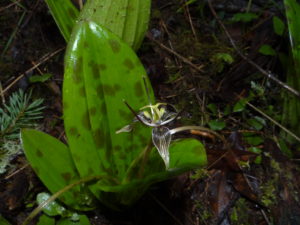
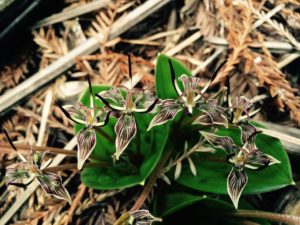
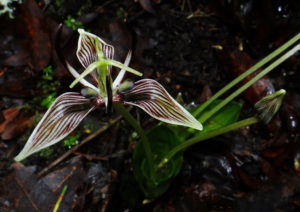 Fetid Adder’s Tongue can be easily spotted sprouting on the forest floor thanks to its unique leaves and flowers. Appearing first are two mottled green and brown basal leaves, which open up to reveal the pedicel (the flowering stalk). Atop the pedicel is the inflorescence which, as with most members of the Lily family, has floral parts in groups of three. What appear to be three large, maroon-striped petals are actually the sepals – petal-like appendages occurring below the flower. The true petals are smaller and maroon-tipped spikes surrounding the three-part stigma. Around the stigma are three anthers, which hold the flower’s golden pollen.
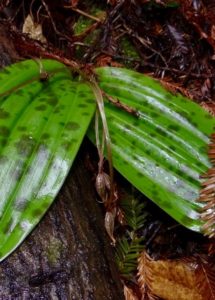
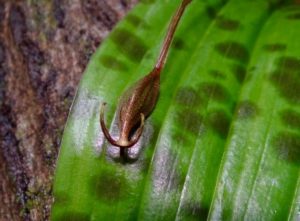
The seeds have a sweet, fleshy part called an elaiosome. Ants in California’s redwood forests, where the fetid adder’s tongue grows, can’t resist this nutritious snack. They carry the seeds away from the parent plant, eat the elaiosome and bury the seeds deep underground. This ensures they are out of the way of both the forest fires that sweep through in summer and the hungry rodents that like eating the seeds.
Forget-me-not, broad leaf (Myosotis latifolia )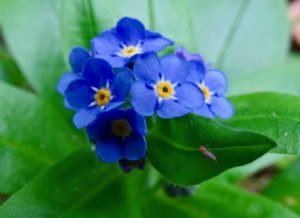
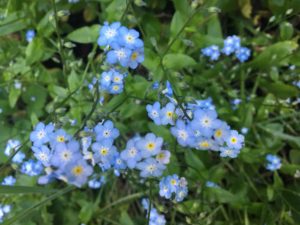
The Forget-me-not (Myosotis) is a genus of flowering plants in the family Boraginaceae. In the northern hemisphere they are commonly called forget-me-nots. This plant is not a native of this area and can be invasive. The Myosotis have 5-merous actinomorphic flowers with 5 sepals and petals. Flowers are typically 1 cm diameter (or less), flat, and blue, pink, white or yellow with yellow centers, growing on scorpioid cymes. Their seeds are found in small, tulip-shaped pods along the stem to the flower. The pods attach to clothing when brushed against and eventually fall off, leaving the small seed within the pod to germinate elsewhere.
Invasive Broad leaf Forget-Me-Nots (Myosotis latifolia ) are everywhere. They are able to form large monocultures, especially in situations where they are in or near a stream. They are still commonly planted in gardens, allowing them to escape into natural environments. They have a perceivable but mild influence on soil nutrient availability, fix substantial levels of nitrogen in the soil making soil unlikely to support certain native plants or more likely to favor non-native species, increase sedimentation rates along streams or coastlines, and degrade habitat important to waterfowl.
Foxglove
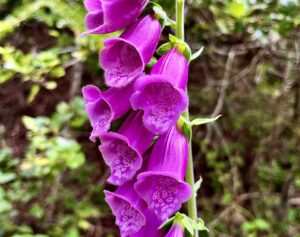
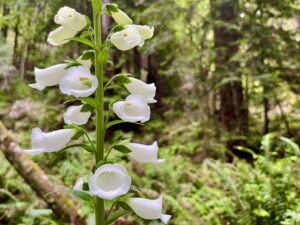
Digitalis is a genus of about 20 species of herbaceous perennials, shrubs, and biennials commonly called foxgloves. This genus is native to western and southwestern Europe, western and central Asia and northwestern Africa. The scientific name means “finger-like” and refers to the ease with which a flower of Digitalis purpurea can be fitted over a human fingertip. The flowers are produced on a tall spike, are tubular, and vary in color with species, from purple to pink, white, and yellow. A group of medicines extracted from foxglove plants are called digitalin. The use of D. purpurea extract is used to increase cardiac contractility (it is a positive inotrope) and as an antiarrhythmic agent to control the heart rate, particularly in the irregular (and often fast) atrial fibrillation. Digitalis is hence often prescribed for patients in atrial fibrillation, especially if they have been diagnosed with congestive heart failure. Digoxin was approved for heart failure in 1998 under current regulations by the Food and Drug Administration. Despite its relatively recent approval by the Food and Drug Administration and the guideline recommendations, the therapeutic use of digoxin is declining in patients with heart failure—likely the result of several factors including a proposed link between digoxin therapy and increased mortality in women.
Geranium, wild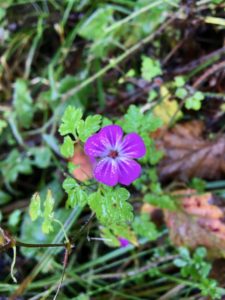 Geranium maculatum, (wild geranium, spotted geranium, or wood geranium) is a perennial herbaceous plant growing to 2 ft tall, producing upright usually unbranched stems and flowers in spring to early summer. The leaves are palmately lobed with five or seven deeply cut lobes. They are deeply parted into three or five divisions, each of which is again cleft and toothed. The flowers have rose-purple, pale or violet-purple (rarely white) petals and ten stamens. In the Northern Hemisphere, they appear from April to June. They are grouped in loose corymbs or umbels of two to five at the top of the flower stems. The fruit capsule, which springs open when ripe, consists of five cells each containing one seed joined to a long beak-like column produced from the center of the old flower. The rhizome is long, and 2 to 4 inches thick, with numerous branches. It is covered with scars, showing the remains of stems of previous years growth. When dry it has a somewhat purplish color internally.
The plant has been used in herbal medicine, and is also grown as a garden plant. Wild Geranium is considered an astringent, a substance that causes contraction of the tissues and stops bleeding. The Mesquakie Indians brewed a root tea for toothache and for painful nerves and mashed the roots for treating hemorrhoids.
Ginger, wild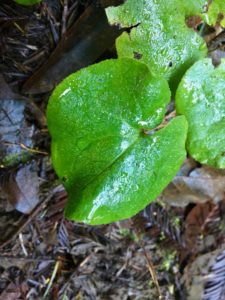
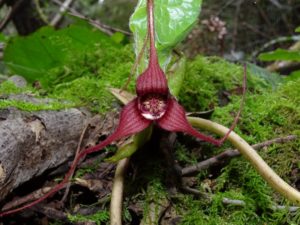 Western Wild Ginger (Asarum caudatum) is found in moist, shaded environments in western US and Canada. It prefers the understory of mixed conifer forests and is often a dominant plant. It reproduces rhizomatously, meaning many mats are formed by one clonal plant connected by a rhizome. It can also reproduce sexually, with its seeds dispersed by ants. Their flowers are pollinated by flies. However, cross-pollination is rare. Ants are attracted by a fatty appendage attached to the seed. The ants carry the entire package back to their colonies. The seed is often dropped outside the nest once the ant realizes only the appendage is edible.
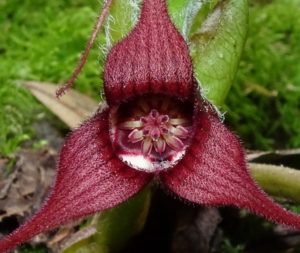 When rubbed or crushed, the leaves give off an aroma reminiscent of culinary ginger (an unrelated plant in a different family).
The outer part of the flower is actually a fused sepal tube, concealing the true flower hidden within the cup. As with other members of the Aristolochiaceae (Pipevine) family, the flowers are slightly stinky and pollinated primarily by gnats and flies, which are abundant before other flying insects emerge for the summer.
Hound’s Tongue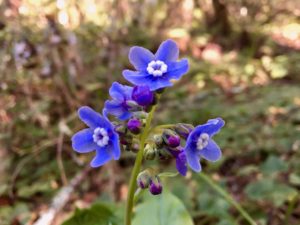
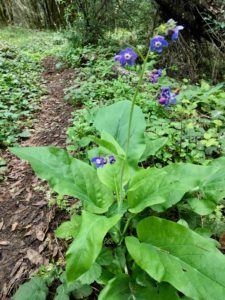
Unlike most of its relatives hound’s-tongue emits a fragrance – a stench that smells like a rat’s nest (that’s why one of the common names is ‘rats and mice’). It has been planted around houses to keep rats and mice at bay, and it has also been used on boats for the same reason. Anyone can test the power of this beautifully-flowered plant for themselves as it thrives happily in the company of humans. Its original habitat stretched to eastern parts of central Europe and the Balkans. Its hook-tipped carpels spread easily over long distances, however, by attaching to people’s clothing and animal fur. One appropriate name that has been used for the plant was ‘monk’s nit’, which is of German origin. This was probably given at the same time as Protestantism arrived in Sweden and when people wanted to ridicule and belittle everything to do with Catholicism and monasticism. Anyone who has ever been near hound’s-tongue plants will not easily forget how easily they stick and how stubborn they are to remove. Hound’s-tongue has also been transplanted on purpose: it was mentioned as a medicinal plant already 7,000 years ago on an Assyrian clay tablet, its root has been used as a sedative and sleep-inducing drug, and it has also been regarded as effective for certain sexually-transmitted diseases. It was later proved that the achenes contain poisonous alkaloids, some of which induce poisoning like South American curare.
Milkmaids
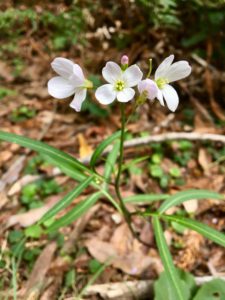
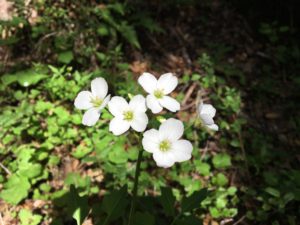 Cardamine californica (Milkmaids), an early bloomer in the mustard family. The white or very pale pink flowers of have four petals, with faint darker veins running lengthways, four sepals, and a cluster of yellow-tipped stamens at the center. Blooms are about half an inch across and form a loose cluster along the upper few inches of the thick green stem. The plant is one of the earliest to flower, starting in January in the most favorable locations. There are five varieties (var californica, cardiophylla, cuneata, integrifolia and sinuata). Leaf shape is quite variable; all are divided into lobes, which are rounded near the base, becoming narrower and more pointed further up the stem.
Modesty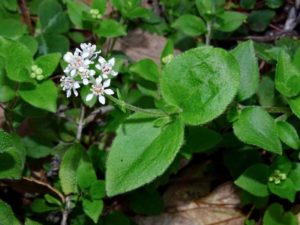
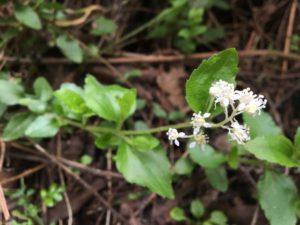
While young, the Modesty (Whipplea modesta) blossoms don’t have any red on them. The red probably indicates that the blossom has been pollinated, or something to do with the development of the seed. This plant used to be in the Mock Orange Family, but now it is in the Hydrangea Family. Whipplea is a monotypic genus – there is only a single species in the genus. It is known by several common names including common whipplea, yerba de selva, and modesty. It is a dicot – the seed has two embryonic leaves or cotyledons. It is a shrub or sub-shrub, and is native to the Pacific Coastal region of the United States. Whipplea appears to have been first recorded in 1853 by the Scottish botanical explorer John Jeffrey in the Umpqua Valley near Mount Shasta, California, and named for Lieutenant Amiel Weeks Whipple (1817-1863), an American surveyor and engineer. Modesty is a natural ground cover in shady forests.
Nettle… yes, it stings!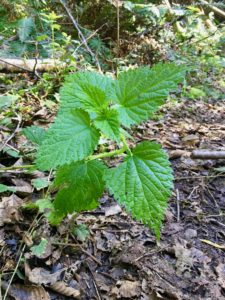 Urtica dioica, often called common nettle, stinging nettle or nettle leaf, is a herbaceous perennial flowering plant in the family Urticaceae.
The leaves and stems are very hairy with non-stinging hairs, and in most subspecies, also bear many stinging hairs (trichomes), whose tips come off when touched, transforming the hair into a needle that can inject several chemicals: acetylcholine, histamine, serotonin, moroidin, leukotrienes, and possibly formic acid. This mixture of chemical compounds causes a painful sting from which the species derives one of its common names, stinging nettle, as well as the colloquial names burn nettle, burn weed, and burn hazel.
Anti-itch drugs, usually in the form of creams containing antihistaminics or hydrocortisone may provide relief from the symptoms of being stung by nettles. Because of the combination of chemicals involved, though, other remedies may be required. Calamine lotion may be helpful. Many natural remedies exist for treating the itching, including dandelion, horsetail, leaf of dock, greater plantain, jewelweed, the underside of a fern (the spores)… many of which are found in the Tannery Creek Reserve… mud, saliva, or baking soda, oil and onions, lemon juice, and topical use of milk of magnesia.
Northern Giant Horsetails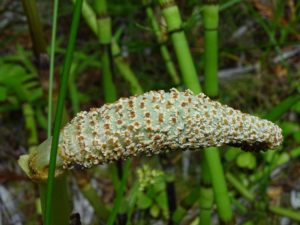 Fertile stem
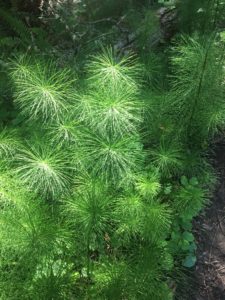 Sterile stem
Northern Giant Horsetails (Equisetum telmateia ssp. braunii) have separate green photosynthetic sterile stems, and pale yellowish non-photosynthetic spore-bearing fertile stems. The sterile stems, produced in late spring and dying down in late autumn. The spores disperse in mid spring, with the fertile stems dying immediately after spore release. Horsetails also spread by means of rhizomes that have been observed to penetrate 4 meters into wet clay soil, spreading laterally in multiple layers. Occasional plants produce stems that are both fertile and photosynthetic.
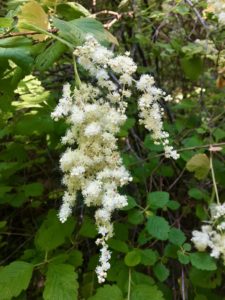
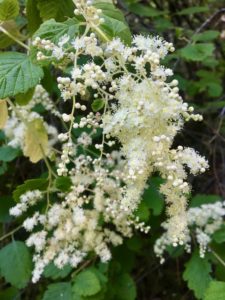
Ocean Spray (Holodiscus discolor)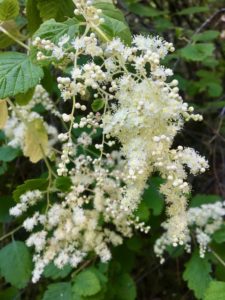
Orchid, calypso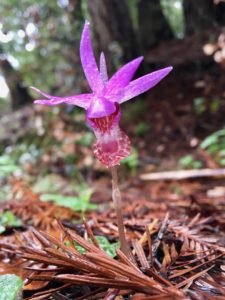
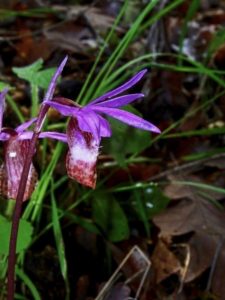
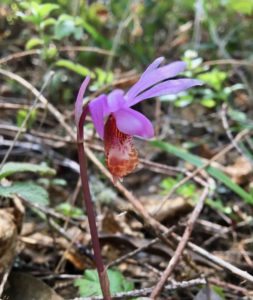 The Calypso Orchid (Calypso bulbosa) is also called the Fairy Slipper. The Calypso orchid, which has been called the most beautiful terrestrial orchid in North America, bears a single, showy flower on a single, dainty, purple stem. The petals and sepals of each intricate and colorful flower are held above a large, highly-modified petal (called the lip) like a crown. The lip is a slipper-shaped pouch, hence this plant’s common name. The flowers, which have a distinct, pleasant, vanilla-like aroma, range in color from rich purple, through shades of pink to white and are lightly veined, while the lip is white to purple with purplish spots, and the inside of the pouch is lined with purple to reddish veins. The area near the throat of the pouch is decorated with three ridges, bearing white or yellow hairs. Each plant has a single, dark green, oval leaf measuring up to 3.5 centimeters long. Both the single leaf and flower stem rise from a shallow corm, with few, short and slender roots. On blooming plants it is sometimes possible to see the top of the corm. The seeds it produces may be the tiniest seeds in the world – and they take about 7 years to blossom. They are totally dependent on their roots being in contact with a specific fungus in order to survive. The species name bulbosa refers to the bulb-like nature of the corms. Calypso comes from the name of the sea nymph in Homer’s Odyssey.
Poison oak An innocent little branch of poison oak on the path just waiting to share its charms with an unsuspecting hiker wearing shorts.
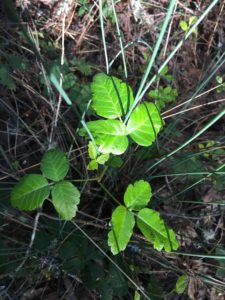
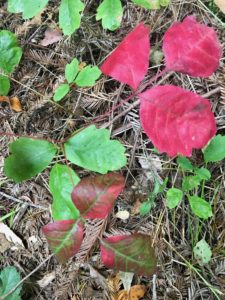
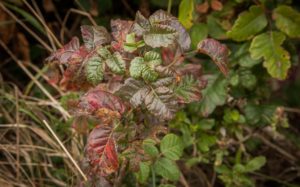
If you aren’t familiar with Pacific poison oak, or Toxicodendron diversilobum, and you hike almost anywhere in California, now is the time to learn how to spot it. Contact with this pervasive plant, directly or indirectly (i.e., by petting a dog that has been exposed to it) can cause you quite a bit of grief. It grows as a ground vine, shrub, or climbing vine just about everywhere in this great state from Spring to Fall.
The leaves are divided into three leaflets, 1.4 to 3.9 inches long, with scalloped, toothed, or lobed edges. They generally resemble the lobed leaves of a true oak, though tend to be more glossy. Leaves are typically bright green in the spring, yellow-green to reddish in the summer, and bright red or pink from late July to October. The leaves and twigs have a surface oil, urushiol, which causes an allergic reaction or dermatitis – an immune-mediated skin inflammation – in four-fifths of humans. Skin contact first causes itching; then evolves into dermatitis with inflammation, colorless bumps, severe itching, and blistering. To prevent this unpleasant experience after possible contact with poison oak, scrub all exposed areas of your body with soap and an abrasive cloth as soon as possible after contact. There are also products available and natural remedies that can be applied.
This site will provide you with good tips about how to spot this pesky plant: http://www.poison-ivy.org/pacific-poison-oak
Redwood sorrel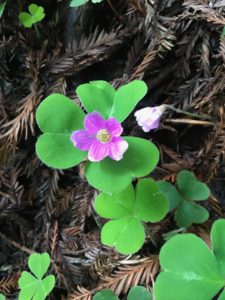
Oxalis oregana, a low plant in patches, with three heart-shaped leaflets on each leaf and one funnel-shaped, white or rose-pink flower at end of each stalk; leaf and flower stalks both about the same length and attached to the plant at ground level.
Redwood violet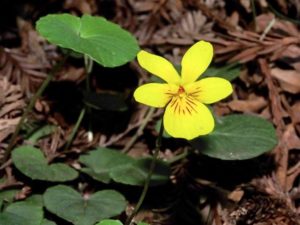 The Redwood violet (Viola sempervirens) has reddish flower stalks, a yellow flower and often is found under Redwood trees. Mature plants produce new plants on above-ground runners. They have shiny evergreen leaves that are thick, heart-shaped, with pointed tips and are spotted purple underneath. The flowers are pale yellow, the 3 lower petals are maroon-veined and the 2 side petals are bearded. The male and female reproductive elements are in the center.
Selfheal (Prunella vulgaris)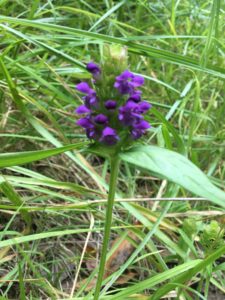 Prunella vulgaris (Self-heal) has leaves that are lance shaped, serrated and reddish at the tip, about 1 inch long and half an inch broad, and growing in opposite pairs down the square stem. Each leaf has 3-7 veins that shoot off the middle vein to the margin. The stalks of the leaves are generally short, but can be up to 2 inches long. The flowers grow from a clublike, somewhat square, whirled cluster; immediately below this club is a pair of stalkless leaves standing out on either side like a collar. Flowers are two lipped and tubular. The top lip is a purple hood, and the bottom lip is often white; it has three lobes, with the middle lobe being larger and fringed upwardly. Self-heal propagates both by seed and vegetatively by creeping stems that root at the nodes.
Self-heal is edible: the young leaves and stems can be eaten raw in salads; the plant in whole can be boiled and eaten as a potherb; and the aerial parts of the plant can be powdered and brewed in a cold infusion to make a beverage.
Scientists have been busy exploring this plant’s powerful uses, from anticancer properties to antiviral capabilities. Chinese herbalists refer to it as the “summer-dry herb” and use it for signs of heat and liver constraint. In Western herbalism, self-heal has been commonly used for all sorts of wounds, being somewhat astringent and demulcent, stabilizing tissue and protecting the skin’s moisture at the same time. In addition to the use of Self-heal on cuts, scrapes and burns, it’s also used for drawing out infections, such as abscesses and boils. Internally, Self-heal has been used for ulcers, especially those in the mouth and throat.
Wake-Robin 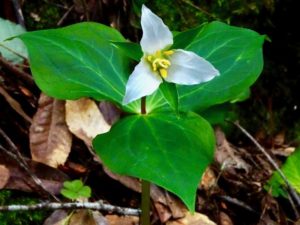 This species is the Wake-Robin (Trillium ovatum) that has the “distinct peduncle” (stalk of an individual flower). This fanciful common name is applied to many flowers of the genus Trillium, not just the red ones, and they were dubbed thus because the flowers traditionally bloomed about the same time that the first robins of spring were sighted.