To learn more about local mushrooms, visit the Sonoma County Mycological Society at www.somamushrooms.org.
Artist’s Conk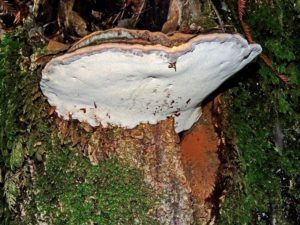 Artist’s Conk (Ganoderma applanatum group) is found in all 50 of the United States! Distinguishing features for Ganoderma applanatum include its unvarnished, furrowed and lumpy, brown-crusted cap surface; its white pore surface, which bruises brown; and its brownish or cinnamon flesh and red-brown spores. It is perennial, and the specimens can develop for dozens of years. The underneath surface has 4-6 tiny (nearly invisible to the naked eye) circular pores per mm; tubes in layers (a new layer is added each year), separated by brown tissue, with each layer 4-12 mm deep. Its pore surface bruises brown and retains the bruising for years if the mushroom is picked and brought inside – but please don’t pick it – leave it for other members to appreciate.
Black Jelly Drops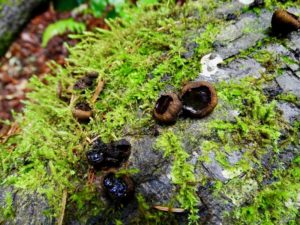 Black jelly drops (Bulgaria inquinans) have many common names because of the way they look: Poor Man’s Licorice, Black Jelly drops, Rubber Buttons, Black Bulgar, etc. When young they look like cup fungi with a shiny black fertile center and a rough brown exterior, but as they age they get flabby and gelatinous, and look a lot like jelly fungi. They are saprobic – feed on decaying matter, and are major decomposers of organic matter.
Comb Hericium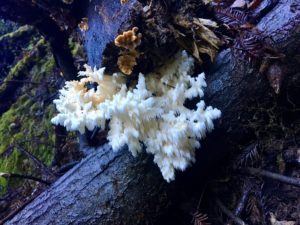
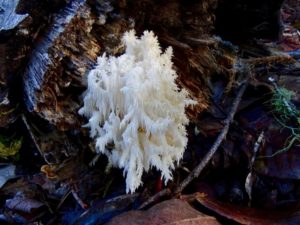 Comb Hericium. Its new scientific name is Hericium coralloides (formerly known as Hericium ramosum).
The comb tooth fungus is a large mostly white mass with an open framework of numerous toothed branches. The fruiting bodies resemble a mass of fragile icicle-like spines that are suspended from either a branched supporting framework or from a tough, unbranched cushion of tissue. It typically grows between 10 and 40 cm wide; and anywhere from 5 to 20 cm high. This saprobic fungi fruits on dead hardwood or on living trees that have been injured. It can be isolitary or clustered.
It is edible when young, with a mild nutty taste. In China and Japan, species of Hericium are highly valued for their medicinal properties. In recent decades there has been considerable research interest in the bioactive properties of this species, and several compounds isolated from H. erinaceus have biological activities, including cytotoxic effects on cancer cells, stimulatory effects on nerve growth factor synthesis, antimicrobial and nematicidal activity, and antitumor activity.
Coral Fungus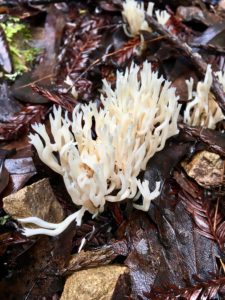 Meadow Coral Fungus (Clavulinopsis corniculata)
Eyelash Fungi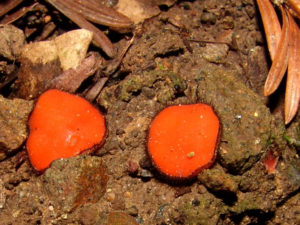 Common eyelash fungi (Scutellinia scutellata) grow on dirt at the edge of the North Rim Trail. The “eyelash cup” is very, very small and easy to miss. These eyelashes are the most distinctive feature and are easily visible with a magnifying glass. Eyelash fungi are Saprophytes and grow on wet, rotted wood, or on damp soil nearby; often growing in clusters; spring through fall; and widely distributed in North America, but rarely seen. (Saprophytes live on dead or decaying organic matter.)
Jack-O-lantern mushroom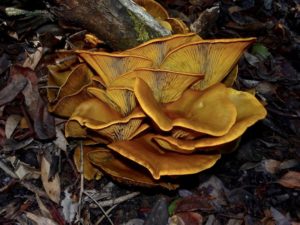 Jack-O-Lantern mushroom – that glows green in the dark!
Omphalotus olearius, commonly known as the Jack-o’-lantern mushroom (or maybe the Western jack-o’-lantern mushroom (Omphalotus olivascens), is a poisonous orange-gilled mushroom that to an untrained eye appears similar to some chanterelles. It is notable for its bioluminescent properties. Unlike chanterelles, Omphalotus olearius and other Omphalotus species contain the toxin illudin S, and are poisonous to humans. While not lethal, consuming this mushroom leads to very severe cramps, vomiting, and diarrhea.
The Jack-o’-lantern mushroom is orange. Its bioluminescence, a blue-green color, can be observed in fresh specimens in low light conditions once the eye becomes dark-adapted. The whole mushroom does not glow—only the gills do so. This is due to an enzyme called luciferase, acting upon a compound called luciferin, leading to the emission of light much as fireflies do when glowing.
Unlike chanterelles, Jack-o’-lantern mushrooms have true, sharp, non-forking gills; this is possibly the simplest trait for distinguishing between the two. Furthermore, if the jack-o’-lantern’s stem is peeled, the inside is orange, while the chanterelle is paler inside the stem.
King Alfred’s Cakes
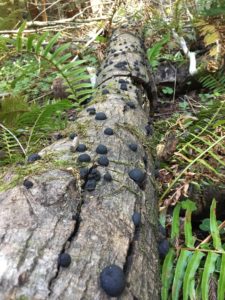
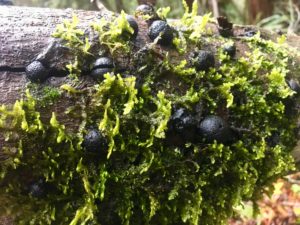 Daldinia concentrica, commonly referred to as King Alfred’s Cakes (a reference to their burnt appearance, of course), because having been given shelter by a peasant woman Alfred, preoccupied by other concerns, was reputed to have inadvertently allowed her cakes to burn, having promised that he would watch her cakes cooking. They are also referred to as Cramp Balls (because carrying them was thought to cure attacks of cramps). These hard, inedible fungi are often found on dead tanoak trees. They are pinkish-brown when young & still growing. they develop over a long period and release pallid, almost colourless spores known as conidiospores (or simply as conidia), which are pinkish white when seen in mass. Once fully grown the fruitbodies turn black. At this mature stage the surface becomes dotted with tiny bumps that are the openings of perithecia, the spore-producing structures located just below the surface. Ascospores, which unlike the pallid conidiospores are jet black, are ejected from these openings in vast numbers, soon covering the surface of the fruitbody and darkening the substrate wood (creating in effect a natural spore print) for some distance around it. Many types of insects and other small animals make their home inside this species of fungus.
Lion’s mane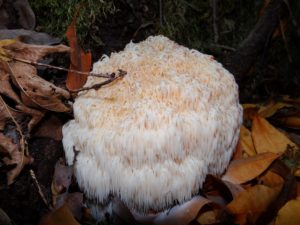 The Lion’s Mane can be quite large. It grows on wounded tree trunks. Underneath the mushroom, you can see that it is releasing thousands of tiny white spores.
Hericium is a genus of edible mushrooms in the Hericiaceae family. Species in this genus are white and fleshy and grow on dead or dying wood; fruiting bodies resemble a mass of fragile icicle-like spines that are suspended from either a branched supporting framework or from a tough, unbranched cushion of tissue. This distinctive structure has earned Hericium species a variety of common names—Icicle fungus, Monkey’s head, Lion’s mane, and Bear’s head are examples.
The fruit bodies typically have short stalks and are attached laterally to the host tree. Mature specimens are easily identified by drooping spines which hang down; the spines may be arranged in clusters or more usually, in rows. Positive identification of immature specimens can be more difficult as they often begin as a single clump, developing their branches as they age. They have no caps and contain spiny amyloid spores and numerous gloeopleurous hyphae filled with oil droplets. The spores are spherical to ellipsoid, smooth or covered with very fine warts.
In China and Japan, some species of Hericium are highly valued for their suspected medicinal properties. There has been considerable research interest in the possible bioactive properties of this species, with several compounds isolated and evaluated in laboratory studies. It’s believed that Lion’s mane mushroom may play a role in neurogenesis, the process by which nervous system cells, known as neurons, are produced by neural stem cells. It may be good brain food for preventing dementia!
Old man’s beard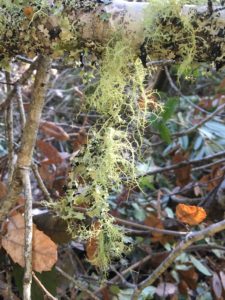 Usnea (Old man’s beard) is a common sight for anyone who walks in the woods. It is the green tangly mass that hangs down from the dead trunks and branches of trees, especially pine trees. Botanically, it is a lichen: a symbiotic integration of a fungus with an algae. There are several species of Usnea with slightly different forms and colors; they belong to the general category of fruticose lichens, commonly called “hanging hair” lichens. The Usneas have a double filament, with an inner core of white to yellow, and an outer portion that is green to grey, the green is contributed by the algae’s chlorophyll.
The appearance of usnea like a mass of cloth fibers immediately suggested itself to primitive people as a useful topical application to wounds and skin inflammation; it can be readily collected and pressed down to make a dressing. This turned out to be a valuable application not just in terms of its structure, but also because usnea contains potent antibacterial components that will help prevent wounds from getting infected and, thereby, contributes to more rapid healing. As a topical antiseptic, it has been used recently in making sophisticated skin creams, vaginal inserts, and mouth washes. It has also been developed into a medicinal herb for internal use. In Europe, it is manufactured, for example, into lozenges to treat oral inflammation (which is basically a topical use, though the content is swallowed); in China, it is used to make decoctions in the treatment of bronchitis with profuse sputum and as part of herbal cancer therapy, particularly for thyroid cancers.
Usnea only grows in area where the air is healthy… good news for those of us who walk the trails of Tannery Creek!
Orange peel fungus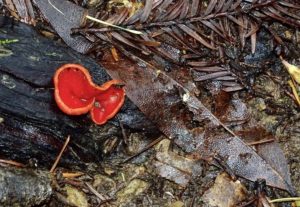 Orange Peel Fungus (Aleuria aurantia) is easily recognized by the sizable orange cups it forms on disturbed ground, e.g. along the edge of paths and dirt roads. Unlike many Ascomycetes (sac fungi), which fruit during the spring, Aleuria aurantia can be found from November through January, the peak of the California mushroom season. It is bright orange, with a fuzzy whitish underside and no stem.
Oyster Mushroom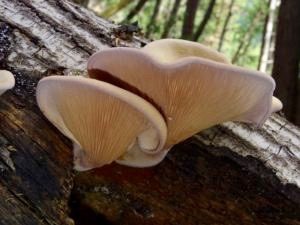 With the rain should come lots of mushrooms in Tannery Canyon and along the roads. This graceful beige mushroom (beige cap, beige gills, off-center almost non-existant stem) could be an Oyster mushroom (Pleurotus ostreatus). But Oyster mushrooms usually have a white cap and white gills – and looking closely there was a tiny tinge of violet under the rolled edges. Carrying a dental mirror can help you see what mushrooms look like under the cap without disturbing them. These are very young mushrooms, and they may look very different when they are mature.
Parrot mushrooms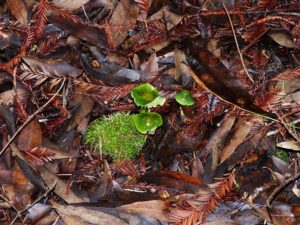
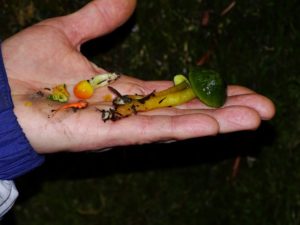 The Parrot Mushroom (Gliophorus psittacinus) is unmistakable if you catch it in its early stages of development, when it is distinctively parrot-green (and decidedly slimy). But it quickly begins to change colors, turning yellow or orange, and then fading to a sort of dingy straw color. By the end of this transformation, the parrot mushroom has become a nondescript little thing, dirty yellowish and very difficult to identify.
Turkey Tail (Common)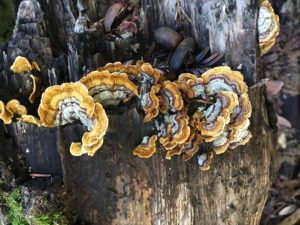
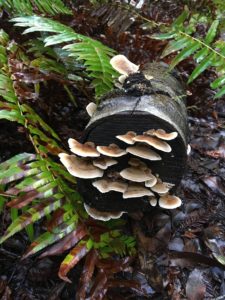
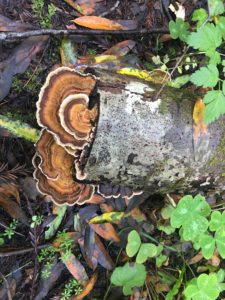 Trametes versicolor is one of the most common mushrooms in North American woods, found virtually anywhere there are dead hardwood logs and stumps to decompose—and, occasionally, on conifer wood too. Its cap colors are extremely variable, but tend to stay in the buff, brown, cinnamon, and reddish brown range. The mushrooms are strikingly “zonate” with sharply contrasting concentric zones of color, and the surface of the cap is finely fuzzy or velvety. Often the zones represent contrasts in texture as well as color, so that fuzzy zones alternate with smoother ones. They have been brewed for thousands of years by the Chinese as medicinal teas.
Turkey Tail is the first FDA approved mushroom to hold clinical trials for cancer. It has been shown to have to have anti-cancer effects.
Turkey Tail (False)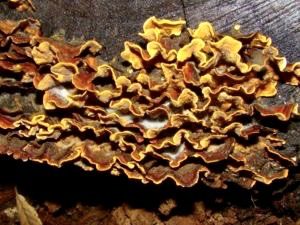
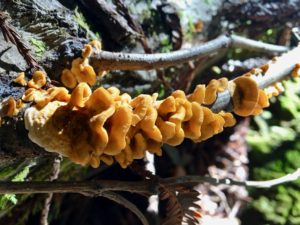
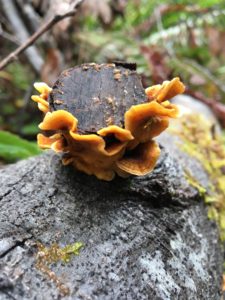
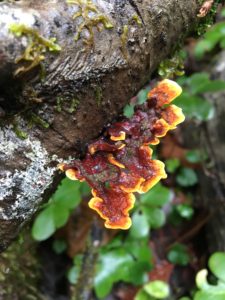
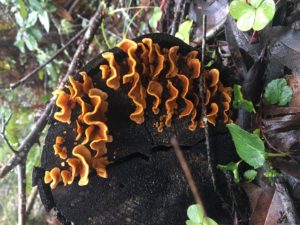 False Turkey Tail is a parchment fungus that belongs to the Stereum hirsutum group. Fungi shaped like this are called Shelf Fungi. They are leathery and brightly colored, particularly when moist. They are hairy toward the center. Sometimes False turkey tails are parasitized by a bright yellow jelly fungus. This specimen is hosting a white fungus in places. Research has shown that it has several medicinal properties, including antioxidant, antimicrobial, antitumor, and immunosuppressive activities.
Turkey Tail or False Turkey Tail???
You can’t tell unless you look at the under side.
If it is flat and white (with tiny pores), it is Turkey Tail. 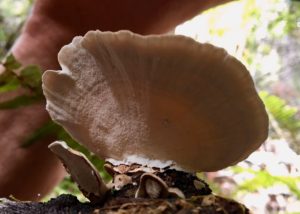
If it has thick, gill-like structures, it is a Gilled Polypore: 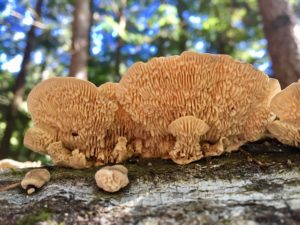
Waxycap mushroom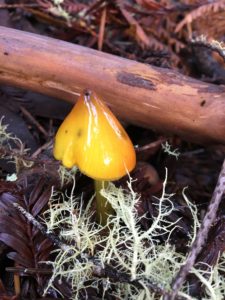 Witch’s hat (Hygrocybe conica)
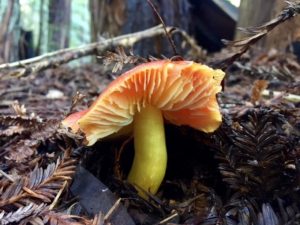 Scarlet Waxycap
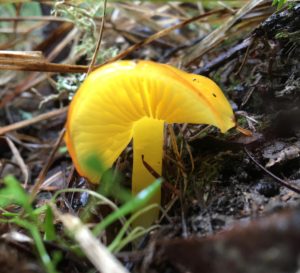
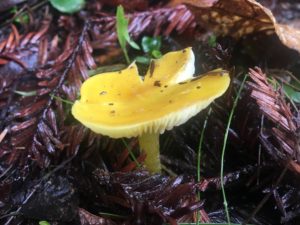
Golden Waxicap (Hygrocybe flavescens). It’s one of the few waxycaps that is not conical.
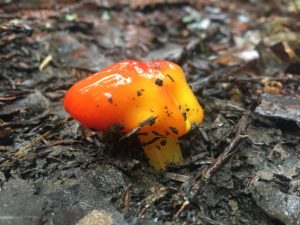
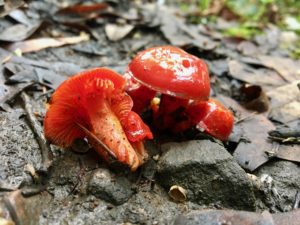
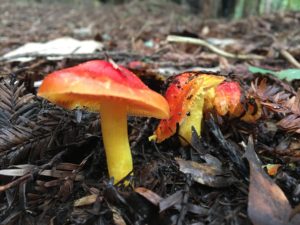
Waxycaps (sticky or slimy cap) prefer to grow by redwood trees. One mushroom book has 123 pages devoted to different species of Waxycaps. All parts of this mushroom will blacken with time, but in this state it will have gills that are white, gray or yellow.
Witch’s Butter
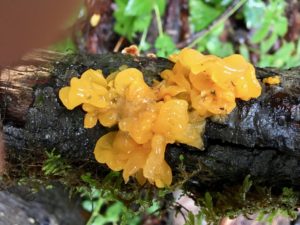
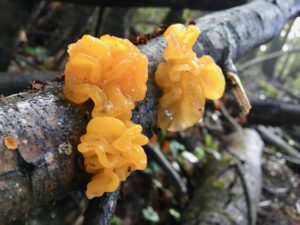
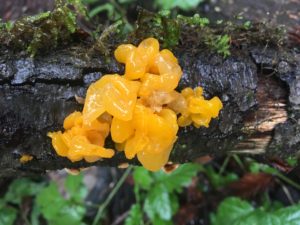
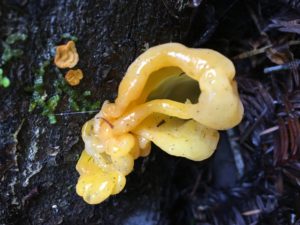
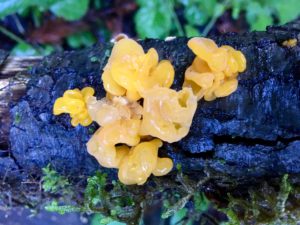 This wood decay, Tremella Mesenterica (common names are Yellow brain, Golden jelly fungus and Witch’s butter), is most frequently found on dead or recently fallen branches. The gelatinous, orange-yellow fruit body of the fungus has a greasy or slimy surface when damp. It grows in crevices in bark, appearing during rainy weather. Within a few days after rain it dries into a thin film or shriveled mass capable of reviving after subsequent rain. This fungus is edible, producing carbohydrates that are attracting research interest because of their various biological activities.
Wood Ears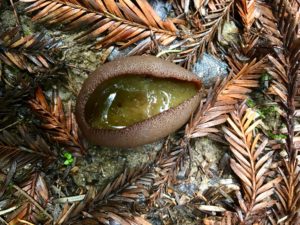 Auricularia auricula-judae is a species of edible Auriculariales fungus found worldwide. The fruiting body is distinguished by its noticeably ear-like shape and brown coloration; it grows upon wood, especially elder. In the West, A. auricula-judae has been used for ailments including sore throats, sore eyes and jaundice, and as an astringent. It has long been used in China, being a popular ingredient in both culinary dishes and in medicine. It is used in Ghana, as a blood tonic. Modern research into possible medical applications has variously concluded that it has antitumor, hypoglycemic, anticoagulant and cholesterol-lowering properties.