History of the preserved land
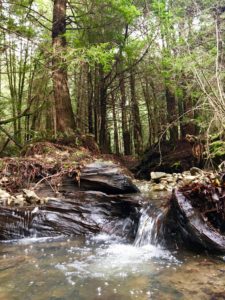
Tannery Creek Reserve is a 187-acre reserve located three miles west of Occidental. The Bodega Land Trust owns and holds a “forever wild” conservation easement on the reserve that includes Tannery Creek canyon and its surrounding redwoods. Richard Yonash is the original donor of the easement, and Mark Jacobsen and Pamela Laird, former neighbors of TCR, helped facilitate the easement and purchased the property after it was in place. In 2022, Mark and Pam donated the property to the Bodega Land Trust.
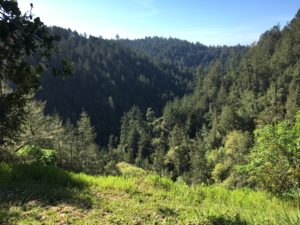
The creek drops more than 500 feet over its middle reach, creating the canyon. There are several waterfalls as well as three major side canyons. The forest is almost entirely redwoods, except in the flatter uplands where a more open forest of fir, oak, and bay prevails. There is no development; the only signs of human activity are old logging roads and trails that go back at least 50 years which are being well maintained by neighbors.
Joy Road, which runs north from Bodega Highway into the hills, was named for the Joy family. As a young man, Benjamin Joy sailed with his brother from England in the 1840s. An adventurous young woman, Elizabeth Machell was also on board. After they arrived in the U.S., she traveled with the Joys to Wisconsin Territory and soon married Ben.
By the 1850s, Ben and Elizabeth were living in Bodega Bay. There they sadly lost all three of their young children. A fourth child, Thomas, was born in 1858, and a daughter Annie, in 1861. Three years later, Ben bought the Thurston Brothers’ mill and moved his family to the forest. Soon after, Minerva, or “Minnie,” was born. Ben expanded his holdings to 1,000 acres and developed a thriving lumber business. During a visit back to England in 1876, he died suddenly. Helped by her teenage children and brother-in-law, Elizabeth took over the lumber operation.
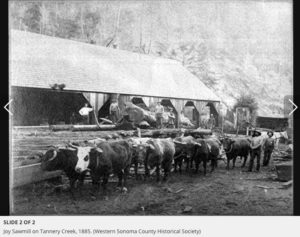
When timber near the mill began running out, Elizabeth relocated to the western part of their property. There they built a steam-powered mill, a mill pond, a home, workers’ cabins, a horse and ox barn and a blacksmith shop. It occupied a clearing with Tannery Creek winding through, crossed by three bridges.
Minnie grew up in the woods, became a teacher and married Alfred Laton, who joined the Joys’ lumber operation. (He was also mayor of Sebastopol). Years later, their daughter, Anita, recounted her childhood with her family and the children of the fallers, teamsters and mechanics who lived and worked at Joy Woods. Pumping the bellows in the blacksmith shop was a big thrill. So was riding the “big wagon” into the woods for a load of logs and watching ox teams skid those logs down from the hills.
She remembered catching salamanders and frogs in the creek; picking huckleberries and strawberries; chewing oxalis “for the spicy taste” and watching tall redwoods topple from the ax. What surprised her, she wrote, was not the loud crash, but the “sudden appearance of a patch of blue sky where just before was a tree.”
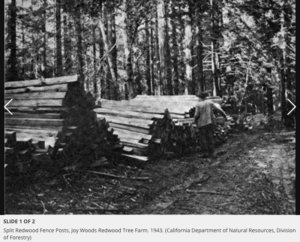
Anita eventually graduated from UC Berkeley and went to live in Oakland. Around 1930, the property was considered for part of a Sonoma Coast state park, but that fizzled. At the onset of World War II, Anita still owned and managed Joy Woods. As part of a government program to aid the war effort, Joy Woods became the first designated tree farm in the Redwood Empire. The program educated forest landowners on sustainable practices that could maintain a healthy ecosystem while providing income from wood products and other things like berries and “woodrat fertilizer.”
The Grove of the Old Trees, 17400 Fitzpatrick Lane near Occidental, is a publicly accessible portion of the original Joy Woods. It has been owned, protected and managed by LandPaths since 2000.
Today, most of us don’t rely on the forest for a living. But we do invite trees into our homes (maybe even from a tree farm) as guests, to honor with decorations and celebrate the season. Christmas trees, as representatives of the forest, are a good reminder that there are ways to tend the earth for the benefit of both human beings and other living things. Taking what we need, giving back what we can in a circle of reciprocity.
A personal story
January, 2018
Darlene LaMont hiked, explored, loved and supported the land now called Tannery Creek Reserve for over 40 years. These are just a few of her memories of time spent in these precious woods.
Darlene, a southern California native, moved to Occidental in 1976. Soon after arriving, a neighbor showed her around the former logging area adjacent to their homes and, for this escapee from “the concrete jungle” it was love at first sight. Soon she got permission from the owners to hike in the canyon. At that time, these two neighbors walked on former logging roads that circled the perimeter and descended to the floor of Tannery Creek. The logging roads that were used in the 1950’s were still in good shape in the 1970’s, narrow, but allowing hikers to walk two abreast. At the bottom of the canyon there were also two small roads that paralleled the creek and led down to the sawmill on Tannery Creek Road in Bodega. Very little is left of these roads today.
The hillsides were also more open than they are today. Only in recent years has cross-country traversing become more challenging with the onset of sudden oak death that has felled many tanoak trees. The road that led to the creek bottom from the SE Rim Trail (today called the Emerald Log Trail) was heavily damaged by the storms of 1983 that caused landslides and washed most of it away. The Twisted Sisters Trail wasn’t developed until around 2011.
In the 1980’s one young woman was given permission to have a sweat house near the V where the Southeast Rim Trail and the Emerald Log trail intersect. The water piping can still be seen in that area today. The very small sweat house was a hand made dome-shaped tee-pee. It was very neat and clean, never resulting in any trash on the trails.
There weren’t nearly as many houses in the area called Joy Woods in the 1970’s, but in the next two decades most of the buildable lots saw homes rise upon them. One by one, a few neighbors began to discover this beautiful canyon and they started individually chipping in to maintain trails throughout the woods. After receiving Reserve status within the Bodega Land Trust in 2011, a trail crew formed under the leadership of Thia Ashonoah that gathered three or four times a year to do work along the paths that we walk on today. A group of 8-10 dedicated neighbors worked with their own tools, cutting back invasive growth, including blackberry bushes and poison oak, clearing downed trees, making steps and bridges, re-routing trails, etc.
In 2011, the Tannery Creek Reserve Neighborhood Association (TCRNA) was formed, an advisory group created with the purpose of supporting and maintaining the reserve. Meetings for suggesting appropriate policies to be applied to the use of the land were held several times per year. Another closely related organization, the Joy Road Neighborhood Association, sponsored an annual picnic. Darlene retired after leading JRNA for 40 years.
Historical development of Joy Woods/Tannery Creek 1542-1951
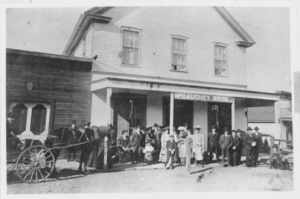
Bodega circa 1889
Howard C. McCaughey records his research and memories of the Joy Woods area in this wonderfully hand-crafted piece written in 1951 (click here). He was the storekeeper at the family’s general store in Bodega in the late 1800’s, the purveyor of everything from nuts to groceries. He was also, like his father before him, the postmaster, which brought everyone from miles around into his store every working day. He was the go-to guy for everyday advice, the gadfly who hounded the county road department about mud and potholes, the acknowledged leader of the political and social life of the coast and, most surely, keeper of the history.
Read more here about the McCaughey family and their importance to this area in an article written by Gaye LeBaron, native daughter and local Sonoma County historian.
Growing up in the early days in Joy Woods
Click here to read a fun document written by Anita D. Laton who grew up in the Joy House that is just below the Tannery Creek Reserve. The Joy family owned all the land from approximately Burl Lane to Taylor Lane and from Joy Road to Tannery Creek Road. Anita had a brother named Burl in Cazadero. This document is extensive and some parts might repeat parts of the reminisces written by Howard McCaughey (above) but it’s worth your time to get to the end as Anita Joy Later describes life in this area at the turn of the twentieth century.
It will take a few moments to download. Be patient. You’ll be glad you did.