Alligator lizard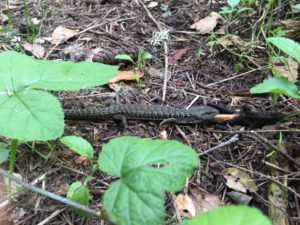
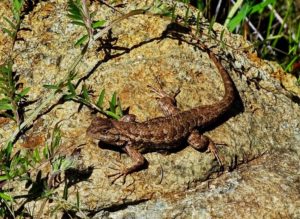 The California Alligator Lizard (Elgaria multicarinata multicarinata) has large rectangular keeled scales on the back that are reinforced with bone – and they can swim like their larger namesake! It is common to find blood-engorged ticks attached to alligator lizards, especially in and around the ear openings. Sometimes if you pick up a lizard too close to the tail, you can accidentally cause it to detach. They drop the tail to distract a predator. Once a California Kingsnake was observed battling a California Alligator Lizard on a hiking trail in Santa Clara County. The alligator lizard clamped its jaws down on the snake’s tail and held on tight even after it died. The snake had to pull and thrash about for more than 20 minutes before the lizard let go of the badly-damaged tail, finally allowing the snake to swallow it.
Banana slug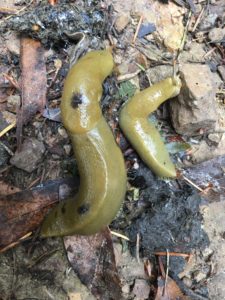
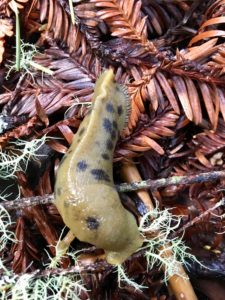
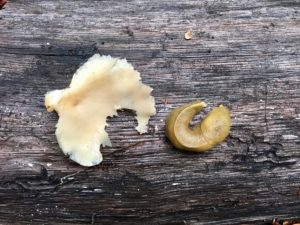
Banana slug is a common name for three North American species of terrestrial slug in the genus Ariolimax. These slugs are often yellow in color and are sometimes spotted with brown, like a ripe (or overripe) banana, although they may also be greenish, brown, tan, or white. The species Ariolimax columbianus sometimes has black spots that are so extensive that the animal looks almost entirely black. Individual slugs will change colors with alterations in food consumption, light exposure, and moisture levels. Color may also indicate whether a slug is healthy or injured or what age it is.
The Pacific banana slug is the second-largest species of terrestrial slug in the world, growing up to 9.8 in long, and weighing up to 4.1 ounces. They have an average lifespan of 1-7 years and can move at 6 1⁄2 inches per minute.
Slugs use two pairs of tentacles to sense their environment. The larger, upper pair, termed “eyestalks,” are used to detect light or movement. The second, lower pair are used to detect chemicals. The tentacles can retract and extend themselves to avoid damage. If a predator bites off a tentacle, the slug can grow a new one.
Dehydration is a major problem for the mollusk; to combat this, banana slugs excrete a thick coating of mucus around their bodies and can also aestivate. To do so, they secrete a protective layer of mucus and insulate themselves with a layer of soil and leaves. They remain inactive in this state until the environment becomes moist again.
Banana slugs are detritivores, or decomposers. They process leaves, animal droppings, moss, and dead plant material, and then recycle them into soil humus. They seem to have a fondness for mushrooms, spread seeds and spores when they eat, and excrete a nitrogen rich fertilizer. By consuming detritus (dead organic matter) slugs contribute to decomposition and the nutrient cycles and are an important aspect of the ecosystem.
Black-Tailed Deer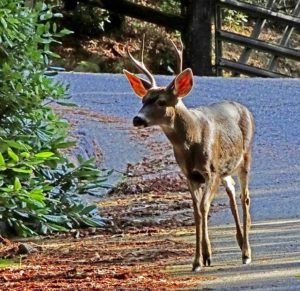 This 2 year old male black-tailed deer is heading for the Tannery Creek trail! The two forms of black-tailed deer that live here in coastal temperate rainforests are a subspecies of the mule deer (Odocoileus hemionus). This species thrives on the edge of the forest. The dark forest lacks the underbrush and grasslands the deer prefer as food, and completely open areas lack the hiding spots and cover it prefers for harsh weather. One of the plants that black-tailed deer browse is western poison oak, despite its irritant content. This deer often is most active at dawn and dusk, and is frequently involved in collisions with automobiles.
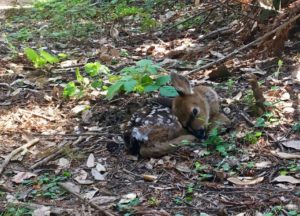 This beautiful, newborn fawn was found on the TCR trail near the Jennifer Drive trailhead in late May, 2018, with no evidence that mom was nearby. Despite the loving support of several neighbors, s/he did not survive the day.
Grape Leaffolder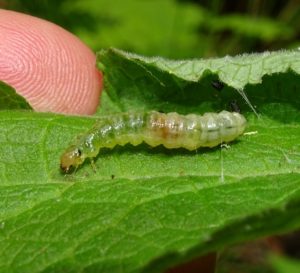 This is a Grape Leaffolder (Desmia funeralis or D. maculalis) larva (caterpillar). Moths of the grape leaffolder are almost black, with two white spots on the forewings and two white stripes across the abdomen. Larvae are translucent but appear greenish because ingested leaf tissue shows through the body wall. Small black spots, located above the second pair of legs, are present on later instar larvae (developmental stage between molts). This helps distinguish them from omnivorous leafroller. Grape leaffolders have three generations a year (about April-May, June 15-July 15, and August). After overwintering as pupae, moths emerge in April or May and lay flat, elliptical eggs singly on either the upper or lower surface of the leaf. Many are deposited against the leaf veins on the underside of the leaf. After hatching, larvae feed between two leaves webbed together for about two weeks. Then each pale green, translucent larva rolls a leaf edge and feeds from the inside on the leaf edge. Larvae turn darker green as a result of this leaf feeding. If disturbed, larvae wriggle vigorously and drop to the ground without a silken thread. Mature larvae construct a separate leaf envelope on the edge of a leaf in which they pupate.
Flower flies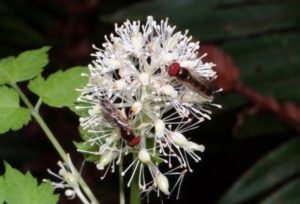 These could be Flower Flies (Toxomerus politus) eating pollen on a Baneberry (Actea rubra) flower. The flies are excellent bee mimics and often hover over flowers and people. (Another common name of this fly is Hover Fly.) The flies frequently are found eating pollen on corn or grass. Their larvae can be found in masses on corn tassels. Despite the warning coloration of these flies, they are harmless – but the Baneberry produces poisonous green berries that turn bright red in the summer. While they are poisonous to humans, birds feast on them – and Native Americans used the juice to poison arrows. Baneberry grows in moist shady areas, but is not frequently seen at TCRNA.
Glowworm, banded Western and a Millipede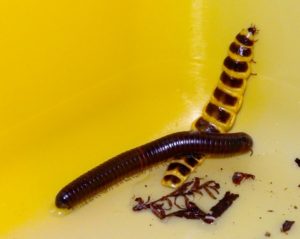 This glowworm (Zarhipis integripennis) specializes in eating millipedes. It can bite the millipede just below the head and paralyze it – then eat it from the neck down. Yummy! The glowworm didn’t seem to be hungry. They are both a little over 3″ long.
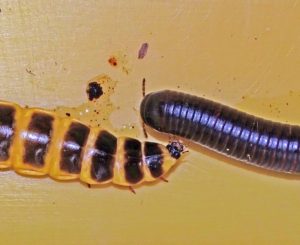 It It is almost impossible to tell if this Western banded glowworm (Zarhipis integripennis) is a male larvae or a female. The female is larviform, meaning she never actually matures into the adult winged form like the male but remains all her life like the juvenile.
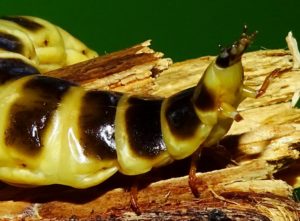 Glowworms have only 6 legs – all in front. At the back end they have a suction cup appendage to help with walking, and so the male can suspend himself and metamorphasize into his adult stage.
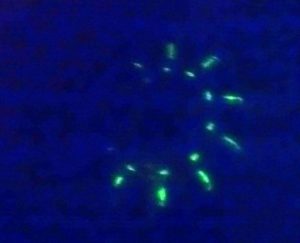 The light emitted by this curled up larva is thought to be aposematic. This is a fancy word that literally means off (apo) sign (sema): Far from attracting mates, it’s a danger sign that this insect is toxic to predators. So in this case the bioluminescence has nothing to do with reproduction. Only the male grubs and adult females can glow.
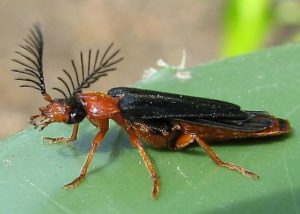 The adult male Glowworm Beetle (This photo is from Wikipedia.). The larvae are active from January to February and adult males come to lights from April to June. The glowworm wandered into my garage (Darlene speaking), so it got its photo taken (above) before I let it go to find a mate in the forest.
Pacific sideband snail
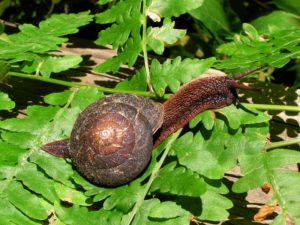
This rufous-colored tree snail is a Pacific sideband snail (Monadenia fidelis). It is endemic (“endemic” means it’s found nowhere else) to the Pacific Coast of North America, from southern Alaska to California. It lives in mossy, cool forests and eats all variety of plants and fungi. It is mostly eaten by shrews, mice, raccoons and snakes. Interestingly, they are active in the fall, spring and summer, but hibernate in the winter months. They and most snails are hermaphrodites, so they have both female and male reproductive organs. When these snails decide they want to mate, they come together and play cupid, literally, with their love darts. Both snails will shoot each other with these love darts, kind of like they’re stabbing each other. The darts are sharp and made from calcium carbonate, chitin or cartilage. Until recently, the exact role the love darts play in the mating process was not fully understood. Current research suggests that the love darts assist with the movement of sperm. The dart contains mucus which has a hormone in it. This hormone is transferred to the other snail when it is shot into their body. The hormone allows more sperm to make their way to the eggs. Class: Gastropoda.
Salamanders, California Slender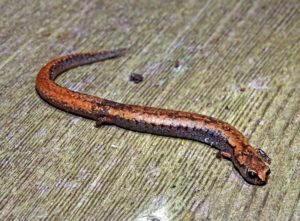 California Slender Salamanders (Batrachoseps attenuatus) have short legs, a long slender body with a narrow head and a long tail and look a bit worm-like. They have only 4 toes on their hind feet. All other California salamanders have 5 toes on their hind feet. They are a member of the family Plethodontidae – Lungless Salamanders.They breathe through their skin and the tissues lining their mouth. This requires them to live in damp environments on land and to move about on the ground only during times of high humidity. They go underground when the soil dries or when air temperature get below freezing. Individuals tend to remain in a small area most of their lives, rarely moving beyond two meters distance. They can live for 8-10 years.
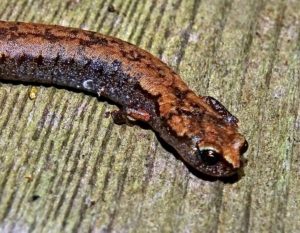 They have vertical slits between the nostrils and upper lip that are lined with glands associated with sensing chemicals and sending biological signals (chemoreception). They coil up and play dead, but also can uncoil quickly and spring away repeatedly bouncing over the ground, then remaining still again to avoid detection. The young develop in the egg and hatch directly into a tiny terrestrial salamander with the same body form as an adult unlike other salamanders. They eat invertebrates, including springtails, small beetles, snails, mites, spiders, and isopods.
Skinks, Western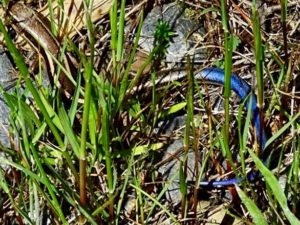 Western Skinks (Plestiodon skiltonianus, formerly Eumeces skiltonianus) are found all over Northern California. Western skinks can be distinguished from similar species by a broad brown or black band originating on the side of head and extending past the hind legs. They spend much of their day basking in the sun. Their diet ranges widely, including spiders and beetles. Western skinks will bite if grasped and will flee if they feel threatened. It is a common but secretive species whose range extends throughout Washington, Oregon, Nevada, Utah, and Wyoming and into western Montana and northern Arizona. They can also live in some areas of Texas. It is widespread in northern California but primarily restricted to the coast in central and southern California.
Spittle bug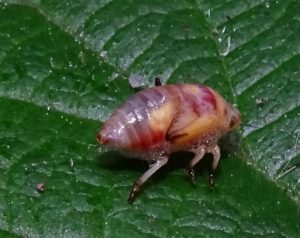 The Spittle bug is the plant-sucking nymph of a Froghopper which encases itself in froth in springtime. While it resembles saliva, it is really frothed-up plant sap. The nymphs pierce plants and suck sap causing very little damage. Much of the filtered fluids go into the production of the froth, which has an acrid taste, deterring predators. A few species are serious agricultural pests. Adult froghoppers jump from plant to plant; some species can jump up to 70 cm vertically: a more impressive performance relative to body weight than fleas. The froghopper can accelerate at 4,000 m/s2 over 2mm as it jumps (experiencing over 400 gs of acceleration). Spittlebugs can jump 100 times their length. These members of the family Clastopteridae have their wings modified to form false heads at the tail end, an anti-predator adaptation. Many adult Cercopidae can bleed reflexively from their tarsi, and the hemolymph appears to be distasteful; they are often aposematically colored Many species of froghopper resemble leafhoppers, but can be distinguished by the possession of only a few stout spines on the hind tibia, where leafhoppers have a series of small spines. Order: Hemiptera.
Spotted Orb Weaver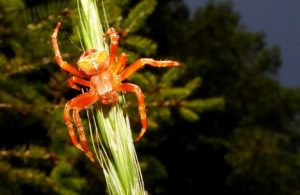 This bright red spider was found walking down a blade of grass along the SE Rim Trail at the edge of Tannery Canyon. The spider was curious and stared right into the camera lens. It could be a Spotted Orb Weaver (perhaps in the genus Neoscona, and maybe the species Gea heptagon).
Ticks 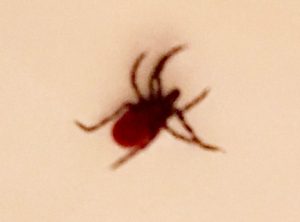
Tick, common name for members of a group of large mitelike arachnids parasitic on mammals, birds, and reptiles. All ticks are bloodsucking parasites. Ticks are found in most parts of the world but are generally limited to those habitats frequented by their hosts-namely, woods, tall grass, and shrubby vegetation-where they climb onto plants and wait to jump on a passing host. Body Structure: Ticks are actually a specialized group of mites and share many features with other mites. In general, they are larger than most mites, ranging from about 0.2 to 0.6 cm (about 0.08 to 0.24 in) in length, although females may be 1 cm (0.4 in) or more in diameter when fully engorged with blood. The adult tick has a mitelike body with a tough skin and four pairs of clawed legs; tick larvae have only three pairs of legs. The mouthparts consist of a paired anchoring organ, or rostrum, covered with backward-curving hooks and equivalent to the pedipalps of other arachnids; and a pair of sharp mandibles that move back and forth in two longitudinal channels on the rostrum.
Behavior: Ticks spend a great deal of time waiting for their hosts. They are particularly sensitive to carbon dioxide and movement-signals that a host is nearby. Their grasping forelegs allow them to climb on a host. They quickly find a protected spot on the host’s body, sink their mouthparts into the flesh, and begin to feed. When full, they drop off the host. In some species, adult males and some nymph stages do not feed.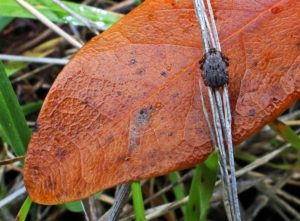
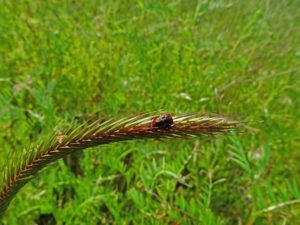 These are both probably Brown Dog Ticks (Rhipicephalus sanguineus Latreille). This tick doesn’t attach to humans, nor does it carry Lime’s Disease. It is unusual among ticks, in that it can complete its entire life cycle indoors. Because of this, it can establish populations in colder climates, and has been found in much of the world. The brown dog tick is a 3-host tick; this indicates that it leaves the host to develop and molt between the larval, nymphal and adult stages. Each stage must locate a host; in a domestic environment this may result in feeding on the same dog (if there is only one or a few dogs present), but there is an opportunity for the same tick to feed on three different hosts. A fully blood-fed female brown dog tick can lay up to 5000 eggs; the number of eggs laid depends on the size of the tick and the amount of blood she ingested.
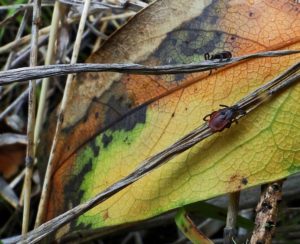 Western Black-legged Tick (Ixodes pacificus) are much smaller than dog ticks and are responsible for transmitting many bacterial diseases such as Lyme disease, Babesiosis, Ehrlichiosis, and Anaplasmosis. The small scutum, or tough, chitinous dorsal abdominal plate, does not cover its entire abdomen, thereby, allowing the abdomen to expand many times when this tick ingests its blood meal. Ixodid ticks require three blood meals to complete development; once each as a larva, nymph and adult.
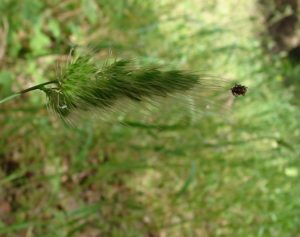 Another Western black-legged tick. Tick questing at the end of a grass stem. It’s legs look all curly – perhaps coiled and ready to jump?