For a description of slime molds, see What’s alive in the woods?
Unidentified slime molds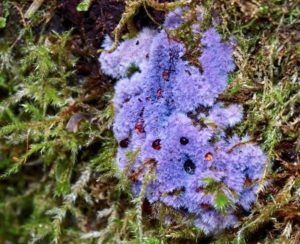
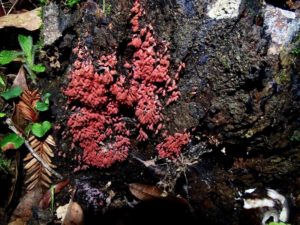
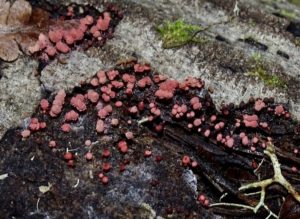
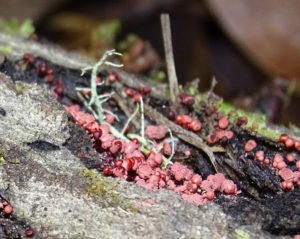 Pink slime mold (unidentified) Stunning pink slime mold, maybe Arcyria insignis an amoebozoa. Amoebozoa is classified as a phylum within either the kingdom Protista or the kingdom Protozoa. The majority of amoebozoan species are unicellular. Arcyria is often an easy to recognize family as the spore mass is typically brightly colored, producing stalked or sessile sporangia. A capillitium often consisting of tubular threads branching at wide angles, smooth or ornamented with spines, warts, cog-like prominences or half-rings, free or attached threadlike elements.
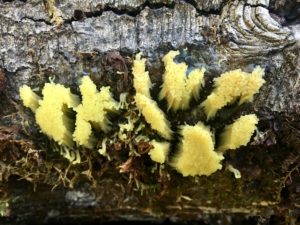 This magnificent yellow slime mold appeared on the Emerald Log Trail in the span of 24 hours, and then was gone again 24 hours after appearing!
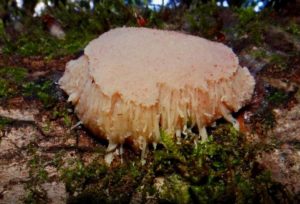 This pinkish slime mold is in the process of beginning to move to a new location.
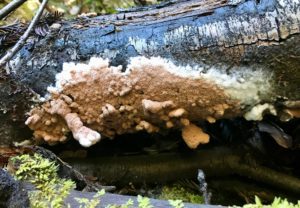 What is this???
Coral slime mold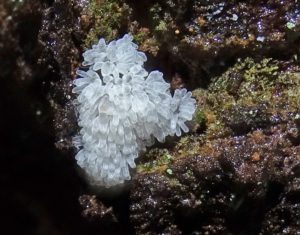 This attractive Coral Slime Mold is most likely Ceratiomyxa fruticulosa. Like the other slime molds, it forms a mass of individual cells that work together to roll across surfaces, voraciously eating bacteria in rotting logs. It is usually translucent white, but can be tinted slightly yellow, pink, or blue-green. The term “slime mold” is a kind of catch-all term for unrelated crawling things that have a similar strange communal lifestyle. This one is related to the amoebae.
Dog’s Vomit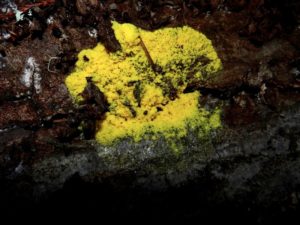 In the Dog’s Vomit slime mold, the transparent plasmodium (like an egg white) changes into an aethalium, a thickened, cushion-like, irregularly shaped structure containing numerous spores. This usually begins in the evening, so that by the next day the “vomit” has “magically” appeared. The whitish, tan, bright yellow, or orange fluffy or foamy-looking aethalia range greatly in size, from a few inches to up to two feet across. The surface of the aethalium sometimes develops dark red liquified areas as it ages, making it look like it is bleeding, but soon matures into a harder mass, losing its bright color. Underneath the crusty, powdery surface a mass of dark brown spores develops. The millions of spores are released when the surface is broken by animals, people, or rain, and are disseminated by wind to other areas. Run a stream of water onto a mature aethelium and a cloud of spores rises up like dark smoke. The mass will eventually disintegrate and disappear.
Wolf’s Milk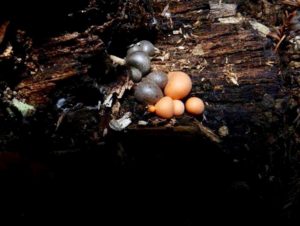 Wolf’s milk (Lycogala epidendrum) is a plasmodial slime mold. These are the fruiting bodies and they are either scattered or in groups on damp rotten wood, especially on large logs. They may excrete a pink paste if the outer wall is broken before maturity. When mature, the color tends to become more brownish. When not fruiting, single celled individuals move about as very small, red amoeba-like organisms called plasmodia – masses of protoplasm that engulf and eat bacteria found in the rotten wood. During one stage Wolf’s milk or Toothpaste slime mold: (Lycogala epidendrum) – its paste becomes ochre-colored and powdery as the spores mature.
Slime mold, see also What’s alive in the woods?